Membrane Roof Installation in Dubai: What It Is, Who It's For, and What's Included in the Basic Service Package
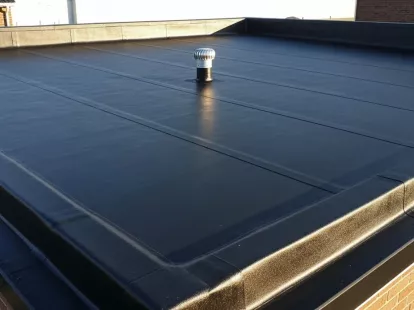
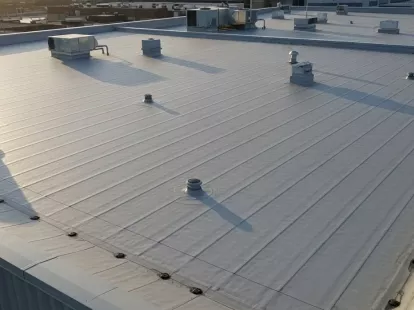
Membrane roof installation in Dubai is the professional application of polymeric PVC and TPO waterproofing systems on concrete substrates for properties of all types. This service is designed for owners of premium villas on Palm Jumeirah and Emirates Hills, management companies of high-rise residences in Dubai Marina, restaurant terrace owners on Jumeirah Bay Island, hotel operators in Downtown, warehouse facility owners in Al Quoz, and industrial property owners in Dubai South. The basic scope of installation includes: free engineer site visit with laser scanning and thermal imaging inspection, roofing system design with SRI heat reflection coefficient calculation, abrasive blasting to Sa 2.5 standard, epoxy priming, lightweight concrete fall formation with laser level control, PVC or TPO membrane installation with staggered seams, hot air welding using automatic equipment, individual seam testing with needle probes, 250 mm membrane upstand to parapets, liquid polyurea flashing sealing, ballast or finish layer installation, and safety railing and walkway installation. The average market price for membrane roof installation in Dubai in 2026 is individually calculated — there are no published price lists, as the final cost depends on membrane type, project area, parapet reinforcement requirements, and location accessibility. We are direct material suppliers, reducing client costs by 18-22% compared to market rates.
Property Typology: From Private Residences to Restaurants and Industrial Complexes
We carry out membrane roof installation across all categories of UAE real estate. Residential sector: premium villas on Palm Jumeirah, townhouses in Dubai Hills, high-rise residences in Dubai Marina. Hospitality sector: hotel terraces and restaurant rooftops in Downtown and JBR. Commercial real estate: shopping malls in DIFC, office buildings in Business Bay, warehouse complexes in Al Quoz and Dubai Industrial City. Public facilities: sports clubs, fitness centers with accessible rooftops, medical centers. Industrial segment: manufacturing plants, logistics hubs in Dubai South, hangars, and car parks. Restaurant business: open rooftop terraces with high pedestrian traffic requiring seamless polyurea waterproofing and non-slip porcelain tile finishes on adjustable pedestals.
Installation Technology: From Concrete Substrate to Finish Layer
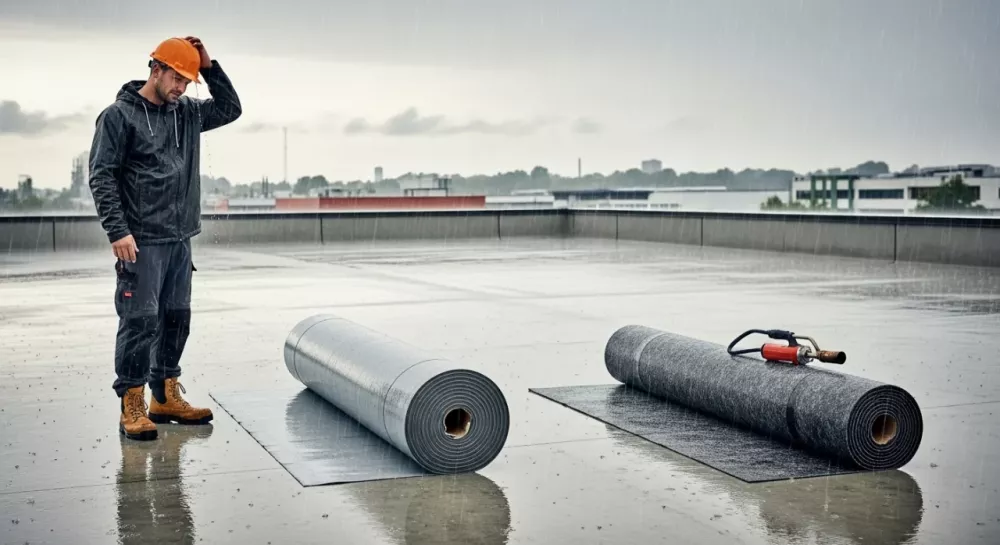
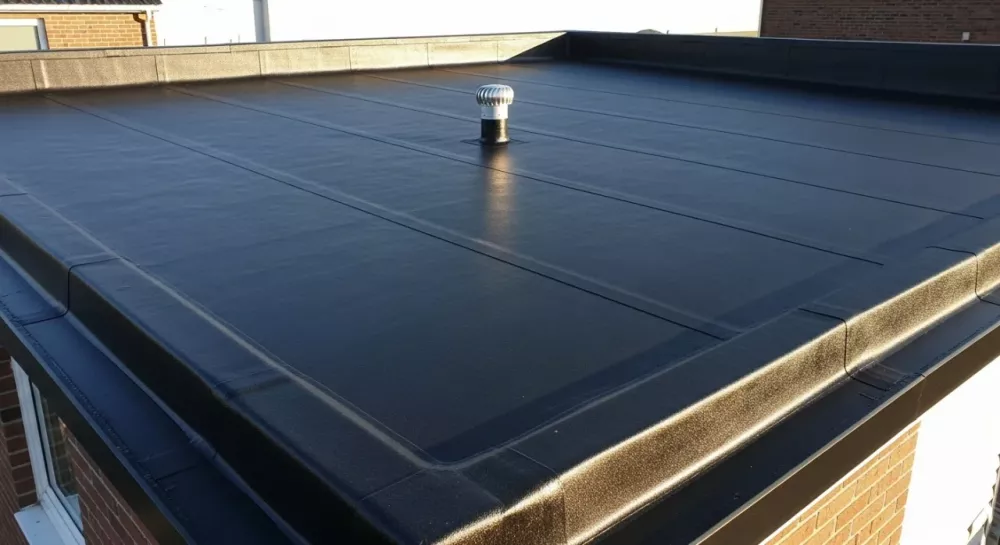
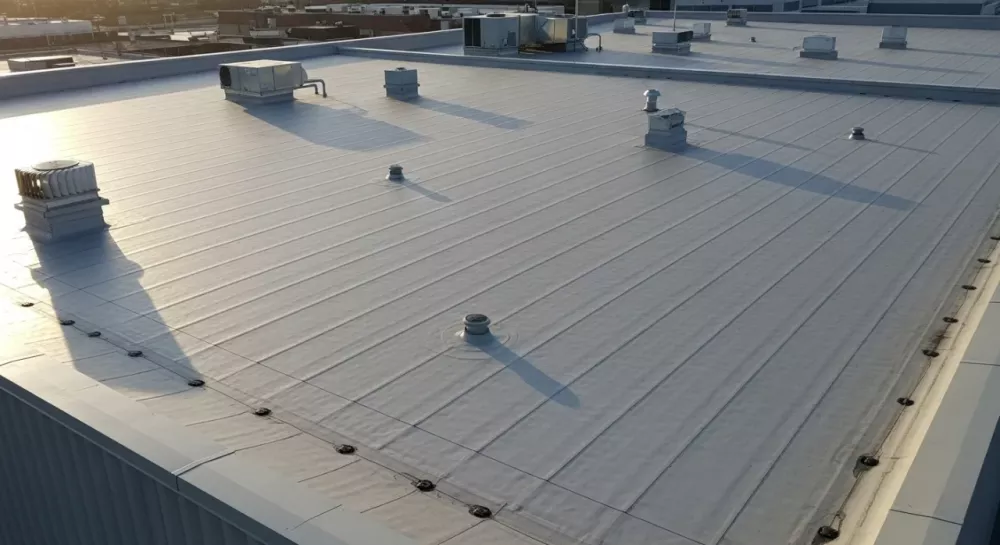
The process begins with abrasive blasting of the concrete substrate to Sa 2.5 standard — removing laitance, oil stains, and loose areas. Epoxy primer is applied to clean, dust-free concrete, ensuring adhesion of no less than 2.5 MPa. Falls are formed using lightweight concrete with laser level control — minimum gradient 1.8% for non-accessible roofs and 2.2% for terraces, restaurants, and leisure areas. After curing, a 45-50 mm cement-sand screed reinforced with fiberglass is installed. 1.5 mm PVC membrane reinforced with polyester mesh is laid with staggered seams and hot-air welded using automatic welding machines. Every seam is tested with a needle probe — tensile strength must exceed 800 N/50 mm. On parapets, membrane is dressed to 250 mm height and secured with galvanized steel telescopic fasteners at 200 mm spacing. Flashings to walls, ventilation shafts, telecom penetrations, and skylights are sealed with liquid polyurea with 3.2 MPa adhesion or formed using prefabricated transition flashings. Finish layer: for restaurant terraces — porcelain tiles on adjustable pedestals, for premium villas — ballast layer gravel, for warehouses — UV-resistant protective coating, for hotels — WPC decking. The complete installation cycle takes 3 to 7 days depending on area and access complexity.
Materials: Direct Supply Without Intermediaries — Save 22%
We are direct importers and suppliers of PVC membranes with SRI 104+ reflection coefficient, TPO membranes for coastal zones with corrosivity category C5 rating, polyurea with 3.2 MPa adhesion, liquid rubber for complex junctions, prefabricated flashings, and fastening systems. The absence of intermediaries reduces material costs by 18-22% compared to market offers. All materials are certified by Dubai Central Laboratory and approved by Dubai Municipality. For Palm Jumeirah and Jumeirah properties, we use TPO membranes with enhanced resistance to salt-laden mist. For restaurant terraces — polyurea with anti-slip additives. For warehouse complexes — reinforced PVC membranes with double-layer polyester mesh.
Emergency Response and Service Area
Free engineer site inspection with thermal imaging — available across Dubai on the day of your request. Emergency leak repair requests during the rainy season are responded to within 90 minutes in premium districts: Palm Jumeirah, Emirates Hills, Dubai Marina, Jumeirah Bay Island. In Business Bay and Downtown — within 2 hours, in Dubai Hills and Arabian Ranches — within 3 hours, in Dubai South, Al Lisaili and Hatta — within 4.5 hours. Scheduled installation commences 3-5 days after contract signing. Our own fleet of access platforms with working heights up to 28 metres and in-house industrial climbers certified to IRATA standards enable us to work on sites of any access complexity without subcontractors.
What We Repair: Typical Membrane Roofing Failures
The most common problem in Dubai is PVC membrane detachment on parapets due to installation errors or building settlement. We reinstate flashings using hot air welding with additional liquid polyurea reinforcement aprons. The second most frequent issue is rainwater drain blockage during the rainy season, causing water ponding and leaks through expansion joints. We carry out hydrodynamic drain cleaning and reinforce waterproofing around drains with epoxy compounds. The third problem is mechanical membrane damage during terrace use: punctures, cuts, and abrasion. We perform localized patching using PVC membrane sections and hot air welding.