Office renovation in Dubai is not just an interior update, but a complex multi-stage approval process involving three levels of regulators, each capable of halting the project for weeks over the slightest technical error in documentation. European and American companies opening representative offices in the UAE often underestimate the strictness of local building codes, where Civil Defense checks every fire exit and fire suppression system with military-inspection precision, and Dubai Municipality requires structural calculations even for moving office partitions. Indian and Pakistani tech startups, accustomed to more flexible procedures back home, encounter the reality of free zone regulations, where the DIFC or JAFZA administration imposes their own approval layers on top of city-wide requirements.
The three-level approval system: who controls what
First critical level — approval from the building's management company or landlord. Unlike residential properties where Emaar or DAMAC control the process uniformly, commercial towers have dozens of different management companies. In a Business Bay tower managed by Asteco, you'll need one approval procedure; in the neighboring tower managed by JLL, another; in a third building with its own in-house property management team, yet another. European companies planning to expand across multiple offices in different buildings discover that no unified approval process exists — each landlord has its own timeline ranging from three to twenty working days, its own deposit requirements from five to fifteen thousand dirhams, and its own contractor registration systems.
Second level — Dubai Municipality permit for fit-out works. This is technical compliance verification with Dubai Building Codes, where every wall, every electrical socket, and every air conditioning duct must meet approved engineering standards. Permit applications can only be submitted through a municipality-licensed contractor — if your European construction company wants to use its own specialists, they must work under the supervision of a local licensed partner. Documentation includes detailed architectural drawings at a scale of no less than 1:50, engineering system plans with load calculations for electrical systems, ventilation and air conditioning designs with indoor air quality standards, and structural assessment if modification of load-bearing elements is planned. The review process takes five to fifteen working days for simple projects and up to a month for complex multi-floor renovations.
Third level — Civil Defense approval for fire safety compliance. This is an independent and separate inspection that can request changes even after municipality permits have been obtained. Every office over one hundred square meters requires at least two fire exits with clear navigation signage and emergency lighting, a fire suppression system with adequate coverage every nine square meters, fire-rated doors for electrical rooms and server rooms, smoke detectors integrated with the building's alarm system, and fire extinguishers in prescribed locations. Arab companies planning luxurious executive offices with custom wooden panels and fabric wall coverings must provide fire resistance certificates for all finishing materials — if a material lacks an approved fire rating, Civil Defense will reject the project regardless of aesthetic appeal.
Free zones vs. Mainland: critical differences in approval process
Dubai International Financial Centre (DIFC) represents an autonomous approval system. Here, landlord approval goes through DIFC Authority with its own architectural guidelines requiring aesthetic consistency throughout the district. Glass partitions must use low-iron glass for visual clarity, lighting systems must meet energy efficiency standards higher than mainland Dubai, and signage is subject to DIFC branding rules. Multinational financial companies relocating from London or New York appreciate DIFC for its regulatory clarity and streamlined processes, but encounter higher approval fees — ranging from ten to twenty-five thousand dirhams compared to two to fifteen thousand in the mainland.
Jebel Ali Free Zone Authority (JAFZA) primarily serves logistics and manufacturing companies. Here, office fit-out approval focuses on industrial safety requirements. If the office is located within a warehouse or manufacturing building, fire suppression system requirements are stricter — sprinklers must have higher flow rates, electrical systems require explosion-proof enclosures if flammable materials are stored nearby, and HVAC design must account for dust control and adequate ventilation for industrial environments. Chinese and Indian manufacturing companies opening sales offices in JAFZA sometimes attempt to use residential-grade materials to save costs, but inspections identify non-compliance and require replacement with commercial-grade alternatives.
Dubai Silicon Oasis Authority (DSO) has established an approval system specifically for technology companies. Here, the emphasis is on high-density computing infrastructure — electrical load calculations must account for server rooms with UPS backup, cooling systems require precision air conditioning with strict temperature and humidity control, and structured cabling must follow telecommunications standards with adequate cable management. American and European tech companies accustomed to California or Berlin office standards find DSO requirements compatible with their expectations but discover that acoustic control regulations in DSO are stricter — open-plan offices require sound-absorbing ceiling tiles and carpeting with minimum acoustic ratings to reduce ambient noise.
Dubai's office districts: how location affects renovation strategy
Business Bay represents a concentrated commercial district with seventy high-rise towers. Renovation here is complicated by tight service elevator scheduling — a single service elevator serves twenty to thirty offices simultaneously, booking is required at least two weeks in advance, and delivery windows are strictly limited from 8 AM to 5 PM. European consulting firms planning fast-track renovations discover that material delivery delays can extend project timelines by a week solely due to elevator availability. Contractor vehicle parking is non-existent — they must use paid public parking at fifty to seventy dirhams per day, which for a three-month project adds nine to twelve thousand dirhams in hidden costs.
Downtown Dubai commercial spaces in towers surrounding Burj Khalifa have the strictest aesthetic guidelines. Emaar Properties, controlling most buildings here, requires maintaining premium fit-out standards — exposed ceiling systems are prohibited, all HVAC ducts and electrical raceways must be concealed, and lighting fixtures must feature contemporary design approved by Emaar's design committee. Japanese and Korean companies opening flagship downtown offices are willing to pay a premium for location prestige but encounter extended approval timelines — Emaar design review adds seven to ten days to the standard permit process and may request changes to align with the district's architectural vision.
Jumeirah Lakes Towers (JLT) commercial properties are popular among small and medium businesses due to more affordable prices while maintaining good connectivity. Here, renovation complexity is lower — most buildings have standardized floor plans with predictable MEP system layouts, landlords are more flexible with approval timelines, and contractor access is easier thanks to dedicated service lifts in newer towers. Indian and Pakistani small and medium enterprises seeking cost-effective office solutions find JLT offers an optimal balance between location convenience and renovation budget predictability. A typical 200-square-meter office renovation in JLT costs between eighty to one hundred twenty thousand dirhams, compared to one hundred twenty to one hundred eighty thousand dirhams in Business Bay for comparable scope of work.

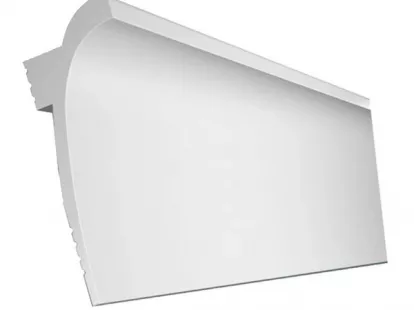
Ceiling Skirting Board (Smooth), 120x45 mm, White
Type: Ceiling skirting board (coving) Material: Ecopolymer Wall dimension: 120 mm Ceiling dimension: 45 mm Profile: Smooth Color: White...
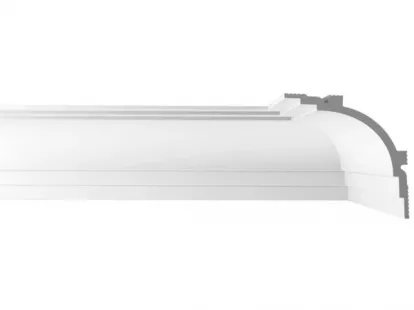
Decorative Molding Corner, White, Paint-Ready
Type: Molding corner (decorative corner piece) Material: Ecopolymer Profile: Smooth Feature: Paint-ready Color: White (base) Packaging and...
Ceiling Skirting Board, 110x110 mm, White, Paint-Ready
Type: Ceiling skirting board (coving) Material: Ecopolymer (high-density polystyrene, XPS) Wall dimension: 110 mm Ceiling dimension: 110 mm Profile:...
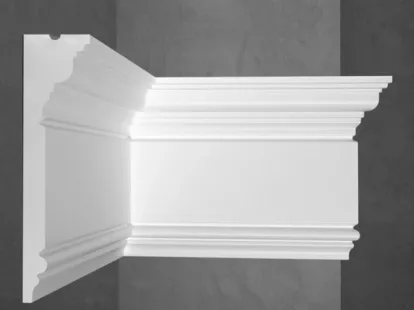
Ceiling Skirting Board (Smooth), 2000x140x60 mm, White, Paint-Ready
Type: Ceiling skirting board (coving) Material: Ecopolymer Length: 2000 mm Wall dimension: 140 mm Ceiling dimension: 60 mm Profile: Smooth...
Ceiling Skirting Board (Smooth), 2000x150x38 mm, White, Paint-Ready
Type: Ceiling skirting board (coving) Material: Ecopolymer Length: 2000 mm Wall dimension: 150 mm Ceiling dimension: 38 mm Profile: Smooth...
Step-by-step work schedule: from planning to completion certificate
Weeks one to two: Initial design development and contractor selection. For office renovation, the selection of a municipality-licensed contractor with proven commercial project experience is critically important. Unlike residential work, where contractors are often generalists, commercial office fit-out requires specialized expertise in MEP system coordination, fire safety systems, and accessibility compliance for people with disabilities. European companies often engage international design firms for concept development, but execution must be done by a local licensed contractor — attempts to use foreign contractors under consultancy agreements lead to approval rejections. Design phase costs range from five to fifteen thousand dirhams for standard office layouts and twenty to fifty thousand dirhams for custom architectural design with structural modifications.
Weeks three to five: Landlord permit application and coordination with the building management company. The documentation package includes a copy of the tenant's business license, the proposed floor plan showing partition and furniture layout, the contractor's trade license and insurance certificate, a method statement describing demolition and construction sequence, and a waste management plan detailing material disposal procedures. The building management company also requires a security deposit — typically five to fifteen thousand dirhams depending on tower class and renovation scope. The deposit covers potential damage to common areas, elevator usage, and cleaning expenses after project completion. Indian and Pakistani companies with multiple offices sometimes negotiate reduced deposits through established property management relationships, but new tenants pay the full amount.
Weeks six to eight: Dubai Municipality permit application and technical review. Architectural drawings must be prepared by a municipality-approved consultant with a valid registration number clearly marked on each sheet. The drawing set includes a demolition plan showing existing conditions, a new partition layout with wall types and fire ratings, a reflected ceiling plan showing lighting locations and HVAC diffusers, an electrical plan with power outlets and data points, and a plumbing plan if kitchen areas or washrooms are being modified. MEP drawings require a professional engineer's stamp with load calculations — the electrical engineer must confirm the building's electrical capacity is sufficient for additional load, and the HVAC engineer confirms adequate cooling capacity for the new layout. Incomplete or inaccurate drawings generate review comments requiring resubmission, extending the schedule by an additional seven to ten days per revision cycle.
Week nine: Civil Defense coordination and fire safety inspection. The inspector may visit the site to assess existing fire protection systems and verify that proposed changes do not compromise building fire safety. Key checkpoints include maintaining minimum egress aisle widths for emergency evacuation — corridors must have a minimum clear width of one meter twenty centimeters, fire exits cannot be blocked or reduced in size, and server rooms or electrical rooms require automatic fire suppression beyond standard sprinklers. American technology companies creating high-density open-plan offices sometimes discover that their preferred workstation layout violates egress path requirements and must redesign for compliance. Civil Defense may also require additional fire extinguishers or emergency lighting beyond the building's baseline installation if the office layout creates higher occupancy density.
Weeks ten to twelve: Permit issuance and security deposit arrangement. After approval from all authorities, the contractor obtains the official fit-out permit with a unique registration number. This permit must be displayed prominently at the site entrance for the entire construction period. The contractor also arranges elevator booking for material delivery — in busy commercial towers, booking slots may be unavailable for weeks, forcing contractors to adjust delivery schedules. Some buildings require material deliveries only during off-hours with premium fees for weekend or evening access. Failure to coordinate delivery timing results in materials sitting in the ground floor loading bay, creating conflicts with building management and potential storage charges.
Week thirteen and beyond: Actual construction execution. Commercial office renovation typically follows a faster schedule than residential due to permitted longer working hours — commercial buildings permit work from 8 AM to 8 PM versus 5 PM in residential. The demolition phase takes three to five days for a typical office, followed by rough MEP installation two to three weeks, partition construction two weeks, and finishing works three to four weeks. Chinese manufacturing companies opening sales offices sometimes request accelerated schedules for earlier occupancy, but rushed work increases the risk of non-compliance defects identified during final inspection, requiring rework and delaying the completion certificate.
Fire safety compliance: what Civil Defense checks
The emergency evacuation system requires a minimum of two independent exit paths from any point in the office. If the office has a single entrance, the second exit is typically through a fire stairwell with a self-closing fire-rated door. Exit navigation signs must be illuminated either through building emergency power or through LED systems with battery backup. Arabic text "مخرج" must appear alongside English "EXIT" for bilingual compliance. European companies sometimes prefer aesthetic integration of emergency signs, but Civil Defense requires minimum navigation sizing with specific brightness standards — attempts to use minimalist designer fixtures result in rejection if they fail visibility requirements from maximum viewing distance.
Fire suppression system coverage is verified through hydraulic calculations submitted by a licensed fire protection engineer. Each sprinkler head must cover a maximum of nine square meters, with head placement accounting for partition walls — if partitions extend to the ceiling slab, additional heads are required on both sides. Suspended ceiling systems create complexity: sprinklers installed above ceiling tiles are insufficient, rather recessed heads penetrating the ceiling plane must be provided. Indian technology companies preferring open industrial ceiling aesthetics actually simplify sprinkler compliance by eliminating the suspended ceiling layer, though they must ensure adequate coverage pattern with fewer visual obstructions.
Server rooms and IT infrastructure areas trigger enhanced fire protection requirements. Standard water sprinkler systems are unsuitable for electronic equipment — Civil Defense requires either an FM-200 gas fire suppression system or a water mist system specifically designed for data centers. Installing such a system adds fifteen to twenty-five thousand dirhams for a typical fifteen to twenty square meter server room. American fintech companies operating trading floors with extensive computing infrastructure sometimes occupy entire floor levels requiring comprehensive gas suppression costing one hundred to two hundred thousand dirhams. The alternative is isolating servers in dedicated rooms with appropriate suppression versus distributing them throughout the open office where standard sprinklers require expensive modifications.
MEP systems: technical requirements and approval process
Electrical load assessment begins with checking the building's available power capacity. The landlord provides the maximum allocable load for the leased space, typically expressed in kilovolt-amperes or kVA. Standard office load assumes ten to fifteen watts per square foot, but technology companies with high-density computing may require thirty to fifty watts per square foot or higher. If calculated load exceeds allocated capacity, the tenant must either reduce equipment density or request additional capacity from the building management company, which may be unavailable without infrastructure upgrades costing tens of thousands of dirhams. British financial services companies installing trading floor equipment with multiple monitors per workstation frequently encounter this limitation and must negotiate capacity increases or modify workspace design.
Lighting design must comply with Dubai Green Building Regulations requiring minimum energy efficiency standards. LED lighting is mandatory for new installations, with minimum efficacy of eighty lumens per watt. Task lighting at workstations must provide five hundred lux illumination levels, while general ambient may be three hundred lux. The emergency lighting system, separate from normal lighting, must activate automatically upon power failure, providing minimum ten lux illumination along egress paths for a minimum of ninety minutes. Japanese corporations accustomed to higher illumination standards in Tokyo offices sometimes design lighting exceeding minimum requirements, which is acceptable but increases power consumption and potential penalties under building energy caps if the tenant exceeds allocated energy budgets.
HVAC system modifications require a mechanical engineer's assessment whether the building's central plant capacity is sufficient for the proposed office density. Standard office design assumes one person per ten square meters of occupancy, but high-density open layouts may reach one person per five to seven square meters, doubling the cooling load requirement. If the building's chilled water system is insufficient, additional tenant-installed split systems may be necessary, adding ten to fifteen thousand dirhams per unit plus ongoing maintenance costs. Additionally, split system outdoor condensers on the building facade require landlord approval, which may be denied in premium towers enforcing aesthetic standards. Korean electronics companies preferring higher employee density for collaborative work environments regularly face this challenge and must either accept lower density or absorb higher cooling costs.
Budgeting commercial renovation: three price levels
Budget level for startups and SMEs starts from three hundred fifty to five hundred fifty dirhams per square meter. This includes basic fit-out with drywall partitions without sound insulation, standard commercial-grade carpet tiles, simple suspended ceiling with standard lighting fixtures, basic furniture not included — tenant purchases separately. A typical two hundred square meter office costs between seventy to one hundred ten thousand dirhams all-inclusive including approvals, contractor fees, and basic MEP connections. Indian software development companies and Pakistani trading firms often select this level for initial setup, planning an upgrade after two to three years as the business grows. The key limitation is poor acoustic performance with thin partitions transmitting sound between meeting rooms and open workspace, creating productivity challenges for teams requiring concentration.
Mid-level from five hundred fifty to nine hundred dirhams per square meter includes sound-insulated partitions with acoustic isolation, modular demountable walls allowing future reconfiguration without demolition, raised access floors for hidden cable management, higher-grade floor covering — carpet or vinyl tile with commercial warranty, enhanced lighting with dimming controls and occupancy sensors. A two hundred square meter office costs from one hundred ten to one hundred eighty thousand dirhams. European consulting firms and American professional services companies typically operate in this range, valuing acoustic privacy for client meetings and flexibility for future layout changes. Raised floors add a ten to fifteen thousand dirham premium but eliminate unsightly cable trays and simplify future IT infrastructure modifications.
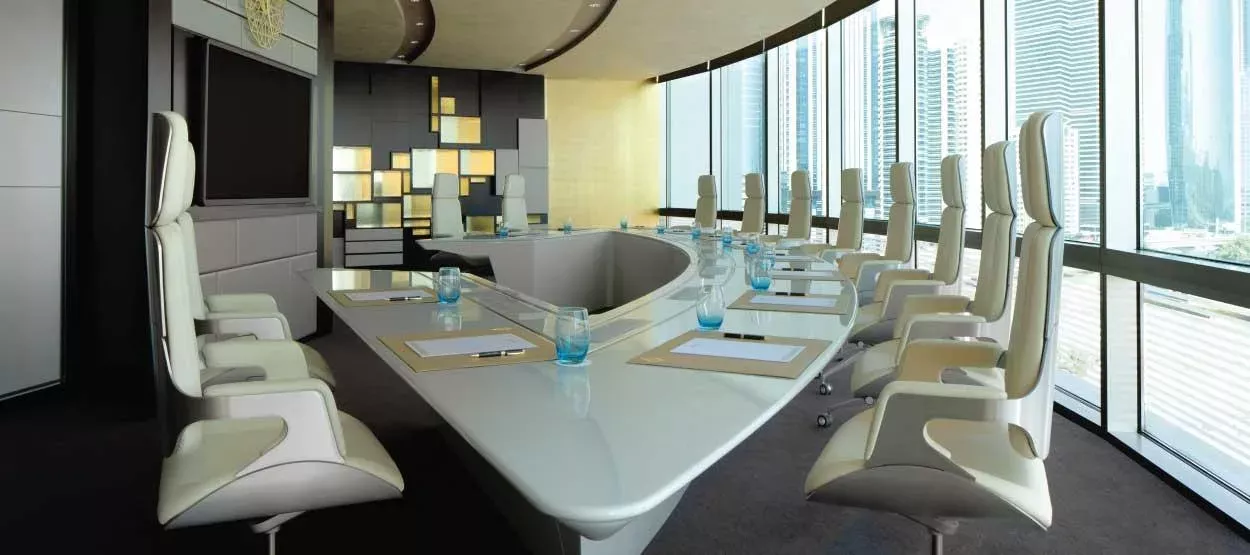
Premium level from nine hundred to fifteen hundred dirhams per square meter delivers executive-class finishes. Glass partitions with integrated blinds for privacy control, custom joinery for reception areas and executive offices, stone flooring in entrance zones transitioning to premium carpeting in work zones, architectural lighting design with decorative fixtures, integrated audiovisual systems in meeting rooms, smart building control for lighting and HVAC automation. A two hundred square meter office reaches from one hundred eighty to three hundred thousand dirhams. Arab family offices, international banks, and multinational corporate headquarters select this level supporting brand image and executive expectations. Return on such investment comes not through direct rental premium — commercial lease rates are determined by location and building class, not tenant improvements — but through talent attraction and client impression during site visits.
Hidden costs: what budgets often miss
Approval fees aggregate from eight to twenty-five thousand dirhams depending on project complexity and location. Dubai Municipality permit costs two to fifteen thousand depending on scope. Civil Defense approval adds one to three thousand. DEWA connection fees if electrical panel is modified or new meters are installed cost two to five thousand. Free zone authorities charge additional processing fees — DIFC adds three to seven thousand, JAFZA two to five thousand. Building security deposits five to fifteen thousand ultimately refundable but tying up cash flow for the project period. American companies accustomed to simpler mainland US permitting processes are surprised by aggregate approval costs sometimes reaching ten percent of total renovation budget.
Furniture and equipment procurement is separate from construction budget. Workstations for open-plan offices cost from eight hundred to two thousand dirhams per seat depending on brand — premium ergonomic chairs from Herman Miller or Steelcase add significantly to per-employee cost versus budget alternatives. Meeting room tables, storage cabinets, reception furniture easily add twenty to fifty thousand for a two hundred square meter office. IT infrastructure — network switches, WiFi access points, server racks if not using cloud — adds ten to twenty thousand. Telephone system installation another five to ten thousand. Budgeting two hundred fifty dirhams per square meter for furniture procurement is a reasonable baseline for mid-level installation, increasing toward five hundred dirhams in premium environments.
Relocation and business continuity costs are often overlooked. If renovating an existing occupied office, the company must either arrange temporary space during construction or conduct phased renovation maintaining partial operations. Temporary space rental for a three-month construction period costs a significant sum — one hundred square meters of temporary space in the same building class costs fifteen to twenty-five thousand dirhams monthly plus fit-out. Alternatively, the phased approach extends project schedule, increasing contractor costs through extended mobilization and creating ongoing operational disruption. Chinese manufacturing companies sometimes schedule renovation during Chinese New Year shutdown periods minimizing business disruption, though contractor availability is tight during this peak holiday season.
Return on investment analysis: how renovation impacts business efficiency
Employee productivity gains are measurable through several metrics. Studies indicate that improved acoustic performance in office environments increases concentration-dependent task efficiency by fifteen to twenty-five percent. For knowledge workers billing at one hundred to two hundred dirhams per hour, acoustic improvements recovering even ten percent of productivity pay back the investment quickly. European management consulting firms operating in Dubai have documented productivity improvements after relocating from budget office spaces to acoustically designed environments, quantifying the benefit through recovered billable hours and reduced employee complaints about noise distractions.
Access to natural light correlates with improved employee well-being and reduced sick leave. Offices with adequate daylight penetration report ten to fifteen percent less absenteeism compared to windowless interior spaces. While building core location limits natural light access, strategic use of glass partitions maximizes daylight distribution from perimeter windows throughout the workspace. Scandinavian companies are particularly sensitive to this factor given cultural emphasis on daylight access, sometimes paying a premium for perimeter office locations despite higher lease costs, viewing reduced healthcare expenses and improved retention as offsetting the expense.
Talent attraction and retention depends on workplace quality. In Dubai's competitive labor market where skilled professionals have multiple employment options, office environment becomes a differentiator. Technology companies competing for software developers find that a modern collaborative workspace with amenities like game rooms, quiet focus zones, and well-designed kitchens improves offer acceptance rates. While difficult to quantify precisely, reduced recruitment costs through improved retention — typical replacement cost estimate of one and a half to two times annual salary — means that workplace investment reducing turnover even marginally generates substantial savings. Silicon Valley companies opening Dubai engineering centers budget premium office environments specifically for talent competitiveness.
Timeline expectations: planning minimal business disruption
Standard office renovation covering one hundred to two hundred square meters requires twelve to sixteen weeks from design start to completion certificate. Breakdown: design development two to three weeks, approval process four to six weeks, construction execution six to eight weeks. Delays occur frequently — approval comments requiring drawing revisions add a week per cycle, material delivery delays from Europe or Asia add two to three weeks if items are on critical path, Civil Defense inspections discovering non-compliant work trigger rework adding one to two weeks. Conservative planning assumes eighteen to twenty weeks total duration, allowing buffer for inevitable delays while avoiding compressed contractor schedules that sacrifice quality.
Phased approach for occupied offices extends schedule but maintains operations. Phase one establishes temporary space — possibly converting meeting rooms into temporary workstations allowing Phase two to renovate part of the main workspace. After Phase two completes, staff moves there while the Phase one area undergoes renovation. This approach doubles project duration to six to eight months total but eliminates need for external temporary space. Korean manufacturing companies with continuous operations prefer the phased method despite extended schedule, valuing business continuity over speed. The critical success factor is clear phase boundaries minimizing inter-phase dependencies avoiding rework.
Accelerated schedule is possible but carries risks. Compressed timeline requires starting construction before final approvals are confirmed, gambling that approval will proceed without major comments. If Civil Defense requires changes after construction begins, rework costs escalate sharply — demolishing completed work and rebuilding to new requirements is both expensive and labor intensive. Additionally, compressed schedules reduce contractor ability to procure optimal materials — they must accept available inventory versus preferred specifications. American startups sometimes pursue aggressive schedules meeting funding deadlines, but experienced facilities managers advise against false economy — rushed renovations often require corrective work within the first year negating initial time savings.
Defect liability period after construction of two to four weeks allows the contractor to rectify deficiencies before final payment. Common defects include misaligned doors requiring hinge adjustment, paint touch-up where walls were damaged during furniture installation, HVAC system balancing ensuring even temperature distribution, non-functioning data points requiring cable rework. A thorough defect inspection process with a detailed snag list prevents ongoing facilities headaches. Japanese corporations with strict quality standards conduct multiple inspection rounds before acceptance, sometimes extending the defect liability period but ensuring every detail meets specification. Releasing final payment to the contractor before defect inspection completion eliminates leverage for prompt defect resolution.
Office renovation in Dubai is a structured investment requiring professional execution at every level. From understanding the three-tier regulatory system to properly budgeting hidden costs, from designing acoustically effective workspace to realistically managing construction scheduling, success depends on treating the project as a complex business initiative rather than a simple cosmetic update. Companies that engage experienced local contractors, allocate adequate budget contingencies, and prioritize compliance over schedule typically achieve outcomes supporting long-term business objectives in one of the world's most dynamic commercial markets.