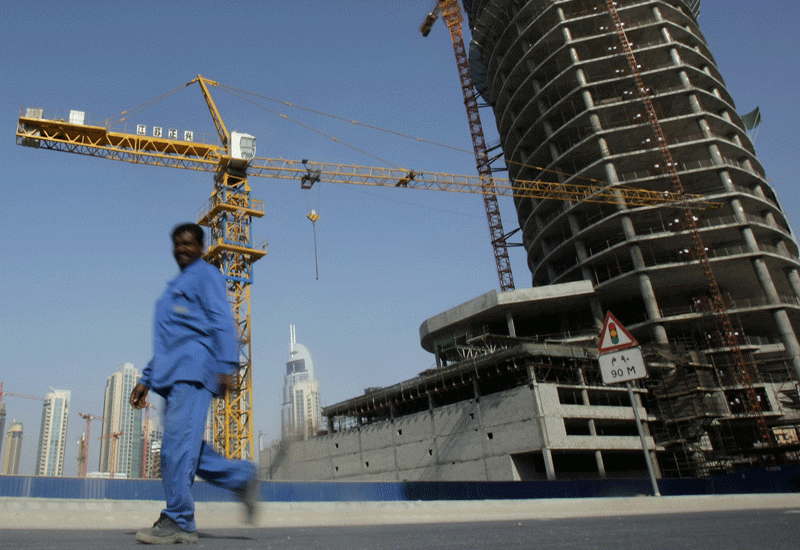
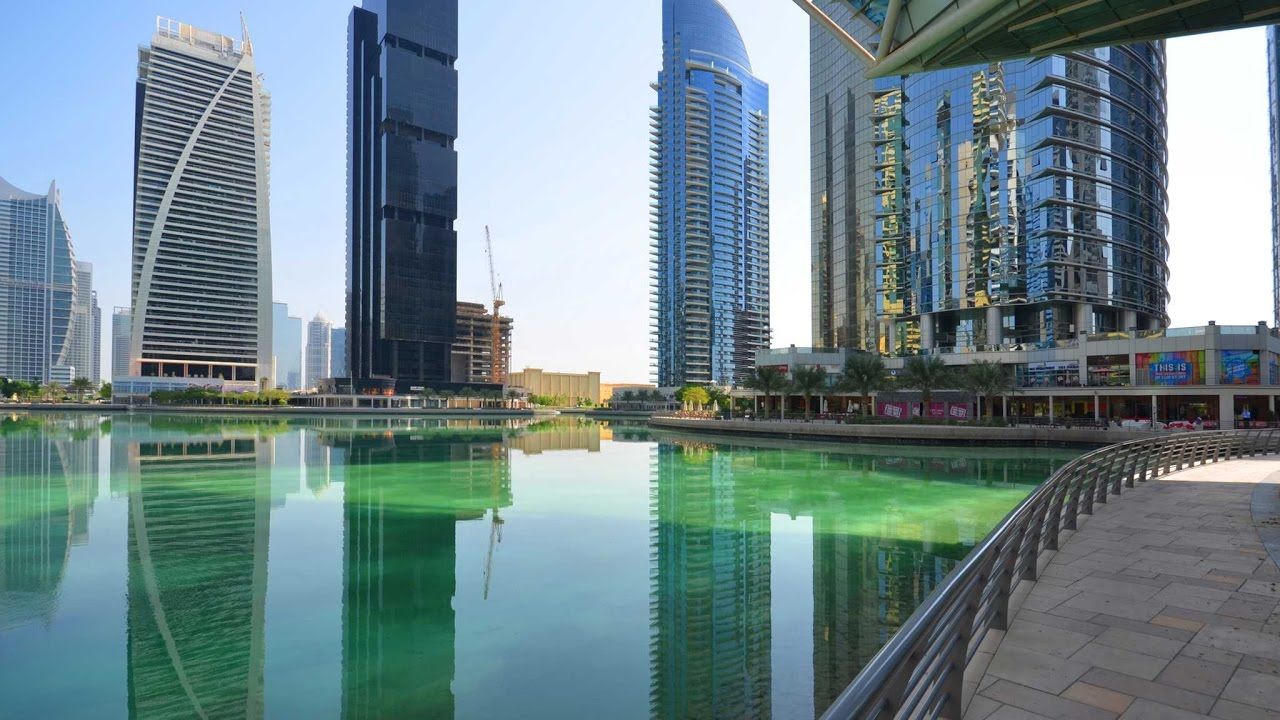
Jumeirah Lakes Towers represents a unique combination of affordability and prestige — eighty towers organised into twenty-six clusters from A to Z around three artificial lakes create a waterfront lifestyle at prices twenty to thirty percent lower than neighbouring Dubai Marina. European professionals, Indian IT specialists and Russian-speaking entrepreneurs choose JLT for its direct connection to the DMCC metro station on the Red Line, pedestrian access to Marina via a covered bridge over Sheikh Zayed Road and a community of sixty thousand residents creating a genuine neighbourhood atmosphere rare in high-rise Dubai. However, apartment renovation in JLT requires understanding the area's specifics — from differences between clusters in building age and developer quality to the approval process via DMCC administration which differs from standard municipal permits.
Complete JLT apartment renovation price list 2026: breakdown by level and type
Cosmetic refresh renovation of a studio of thirty-five to forty square metres starts from four hundred fifty to eight hundred fifty dirhams per square metre. For an apartment of thirty-five square metres, this amounts to sixteen to thirty thousand dirhams including repainting walls with paint resistant to the high humidity of the lake area, replacing flooring with waterproof LVT vinyl tile to prevent swelling from condensation, upgrading light fixtures to modern LED models and cosmetic updating of the bathroom without altering the plumbing lines. Completion time is two to three weeks subject to quick permit approval from the building's management company. Indian and Pakistani young professionals often choose this level for their first home, minimising initial costs.
Standard renovation ranges from eight hundred fifty to one thousand three hundred fifty dirhams per square metre. A one-bedroom apartment of fifty to seventy square metres costs from forty-five to ninety thousand dirhams including partial reconfiguration combining the kitchen with the living room, complete bathroom replacement with a two-layer waterproofing membrane system critical for JLT due to proximity to the lakes creating high humidity, new electrical wiring and plumbing replacing old aluminium wires with copper ones required by modern electrical codes, quality flooring of engineered wood or premium vinyl tile with a commercial warranty. The schedule is ten to fourteen weeks from DMCC permit submission to final inspection.
Premium renovation ranges from one thousand three hundred fifty to two thousand two hundred dirhams per square metre. A two-bedroom apartment of seventy to ninety square metres requires a budget of one hundred to one hundred fifty thousand dirhams. A three-bedroom apartment of one hundred to one hundred fifty square metres reaches one hundred fifty to two hundred fifty thousand dirhams. European and Arab families in this segment expect Italian kitchens from brands such as Scavolini or Aran with integrated Miele or Bosch appliances costing thirty to fifty thousand dirhams, marble bathrooms with Grohe or Hansgrohe fixtures costing twenty to thirty-five thousand dirhams per bathroom, smart home systems including Lutron lighting and Nest climate control costing ten to fifteen thousand dirhams.
Complete gut renovation exceeds two thousand two hundred dirhams per square metre, reaching three thousand for luxury projects. This includes structural changes relocating load-bearing elements after obtaining engineering approval, complete replacement of MEP systems including chiller line upgrading and DEWA load increase, acoustic insulation between rooms critical in JLT's high-rise towers where sound transmission through concrete slabs can be an issue, vapour barrier in bathroom walls preventing moisture penetration into insulation. Russian and Kazakh owners planning long-term residence invest in this level, viewing the apartment as a permanent home.
Individual rooms have their own price ranges allowing a phased approach. A bathroom costs from twelve to forty-five thousand dirhams depending on size and level. Basic updating of five square metres with new standard commercial-grade tiles, replacement of fixtures with mid-range quality and re-waterproofing costs twelve to eighteen thousand dirhams. A premium bathroom of the same size with large-format Italian tiles, a rain shower system, heated towel rails and luxury fixtures reaches thirty-five to forty-five thousand dirhams. A critical factor is enhanced waterproofing due to high humidity, especially in clusters directly on the lake where condensation inside walls is a serious problem.
Kitchen renovation costs from fifteen to sixty thousand dirhams. A standard L-shaped kitchen of seven to eight square metres with laminated cabinets, quartz countertops and mid-range built-in appliances costs fifteen to twenty-eight thousand dirhams. A premium kitchen of the same size with Italian cabinets, Corian or marble countertops, high-end appliances and custom lighting reaches forty-five to sixty thousand dirhams. An important consideration for JLT is material delivery lead times as many towers have restricted goods lift access requiring forty-eight hours advance booking and delivery only during specific hours from eight in the morning to six in the evening.
JLT clusters: how location affects renovation cost and strategy
Clusters D, E and H are the most desirable residential zones in JLT due to direct lake views, well-maintained lobbies and reliable building management. Saba Towers in Cluster D are three towers known for spacious layouts and reasonable service charges of twelve to fifteen dirhams per square foot annually compared to eighteen to twenty-two in newer luxury towers. LakeCity Tower also in Cluster D offers lake-view apartments with a functional gym and 24/7 security. Concorde Tower and Al Seef Tower in Cluster E have direct lake access with some of the best ground-floor restaurants in JLT, creating a lively pedestrian environment. Renovation in these clusters justifies premium materials as they retain resale value — quality renovation adds fifteen to twenty percent to market value.
Clusters J, K and L near DMCC metro station offer the highest foot traffic and ease of rental, making them optimal for investors buying to let. Proximity to the metro means a five-minute walk for tenants working in commercial zones such as Media City, Internet City or Marina, creating consistent rental demand. Fortune Executive Tower in Cluster T, Goldcrest Views in Cluster S and Armada Towers are all metro-close locations commanding a rental premium of twenty to thirty percent higher than equivalents in distant clusters. The renovation strategy for investment property in these clusters focuses on durable mid-range finishes that maximise rental yield without over-investing in premium materials.
Clusters A and B facing Sheikh Zayed Road suffer from road noise, especially on lower floors up to the tenth to twelfth floor. Soundproofing becomes a critical improvement for these apartments — installing double-glazed windows with laminated acoustic glass adds eight to twelve thousand dirhams to the renovation budget but transforms livability. Acoustic underlay beneath flooring adds three to five dirhams per square metre, reducing impact sound transmission to neighbours below, important in multi-storey towers where noise complaints can lead to disputes with building management. European families with children particularly value these acoustic improvements, viewing them as an essential investment in quality of life.
Clusters O and N near the JLT park offer a quieter environment and family-friendly atmosphere with playgrounds and a dog park creating a sense of community. These clusters attract long-term residents rather than short-term tenants, meaning renovation here should focus on durability and timeless design, avoiding trendy finishes that quickly date. Indigo Tower in Cluster Y and Silverene Tower in Cluster V are newer developments built after 2010 with more modern MEP systems and better building management, reducing maintenance headaches. Renovation in newer towers is simpler as existing infrastructure already meets current codes.
Building age varies significantly across JLT, creating different renovation challenges. Towers built in 2005–2008 in Clusters A, B, C often have outdated MEP systems with aluminium wiring requiring full replacement with copper for safety compliance and adequate power for modern appliances and electronics. HVAC systems in these older towers may use less efficient chiller technology, increasing ongoing cooling costs if not upgraded. By contrast, newer towers in Clusters S, T, U built after 2012 have more energy-efficient systems and better insulation, reducing both renovation costs and long-term utility bills.
Metro station access varies by cluster, affecting rental appeal and resale value. Clusters D, E, F are closest to DMCC metro station with a five to seven minute walk, making them premium for commuting professionals. Clusters S, T, U, V, Y are also close to Sobha Realty metro station with similar five to seven minute access. Clusters in the middle of the development such as M, N, O require a ten to fifteen minute walk to the nearest metro station, which is acceptable for most tenants but less desirable than direct proximity. This difference in metro access is reflected in rental rates, with metro-close apartments commanding ten to fifteen percent higher rents for equivalent square footage.

Compact Vinyl Wallpaper on Non-Woven Backing (1.06x10.05 m)
Type: Compact vinyl wallpaper. Backing: Non-woven. Coating: Vinyl (hot stamping). Roll size: 1.06 m x...
Glass Fiber Wallcoverings BauTex Luxury Lux 2 (1x25 m), density 260 g/sq.m
Type: Glass fiber wallcoverings (glass fabric wallcoverings). Pattern / Texture: Embossed (relief), "Bark" pattern. Density:...
Primed Glass Fiber Wallcovering Wellton (1x25 m), density 200 g/sq.m
Type: Glass fiber wallcovering (also known as "painter's canvas"). Condition: Primed (ready for painting). Density: 200...
Vinyl Paintable Wallpaper on Non-Woven Backing 1.06 m x 25 m.
Type: Paintable wallpaper. Backing: Non-woven. Coating: Vinyl, textured (embossed). Roll size: 1.06 m x 25 m....
Vinyl Paintable Wallpaper on Non-Woven Backing
Type: Paintable wallpaper. Backing: Non-woven. Coating: Vinyl, textured (embossed). Roll size: 1.06 m x...
DMCC approval process: step-by-step guide from application to completion
Obtaining a renovation permit in JLT begins with applying for a No Objection Certificate through your tower's management company. Unlike other areas of Dubai where the process goes directly through Dubai Municipality, JLT is managed by DMCC administration which has its own approval system. The first step is to obtain an application form from your building's management office, usually located on the ground floor of the tower or accessible via an online portal if your tower uses a digital system. The form requires basic information about the apartment owner, details of the licensed contractor who will perform the work, and the proposed scope of renovation.
The documentation to be submitted includes a copy of the title certificate or rental contract for tenants performing permitted improvements, the contractor's trade license issued by Dubai Municipality, the contractor's valid liability insurance covering at least five hundred thousand dirhams, a floor plan showing the proposed changes if any, and a method statement detailing what materials will be used and what procedures will be followed to minimise disturbance to other residents. European companies are often surprised by the method statement requirement which in their home countries is not usually required for residential renovations, but in JLT it is mandatory even for cosmetic work.
The renovation deposit ranges from two to five thousand dirhams depending on the tower and scope of work. This deposit is refundable upon completion and final inspection confirming that common areas have not been damaged and all construction waste has been properly removed. Additionally, a separate service lift deposit is required, typically five hundred to one thousand dirhams for the renovation period. Indian and Pakistani contractors familiar with the JLT system usually include these deposits in their quotes, but Western contractors working in JLT for the first time sometimes overlook them, leading to unexpected additional costs for the owner.
Service lift booking is required at least forty-eight hours in advance, coordinated through the building management office. In busy towers, especially in Clusters D, E, H with high occupancy rates, lift slots may be booked weeks ahead, requiring careful planning of material delivery schedules. Service lift availability hours are typically eight in the morning to six in the evening, Monday to Saturday, with no deliveries permitted on Sundays and Friday mornings during Juma prayer. During Ramadan, hours are further restricted to ten in the morning to four in the afternoon, creating logistical challenges for projects scheduled during this period.
Permit processing time varies from five to ten working days for simple renovations and up to fifteen days for more complex projects involving structural changes. DMCC administration reviews the application to ensure the proposed work complies with building codes and will not compromise structural integrity or building systems. If the application requires changes or additional information, a notification is sent back to the applicant, adding a further three to five days to the schedule per revision cycle. Russian owners planning fast renovations must account for this processing period when setting expectations for move-in dates.
Working hours are strictly enforced in JLT with permitted noisy works only from eight in the morning to six in the evening, Monday to Saturday. Sunday is completely prohibited for any type of work, reflecting the UAE weekly day of rest. Friday work is technically permitted after Juma prayer around one in the afternoon, but many building management companies recommend avoiding noisy works all day Friday to respect Muslim residents' needs for rest and prayer. A first violation of working hours results in a written warning, a second violation incurs a fine of one to two thousand dirhams, a third violation leads to suspension of the renovation permit and potential revocation.
Waste management is regulated by specific JLT rules. All construction waste must be removed via the service lift — using the rubbish chute for construction materials is strictly prohibited and incurs immediate fines. Contractors must arrange a skip bin through Dubai Municipality approved waste management service providers, with typical costs of five hundred to one thousand five hundred dirhams per skip depending on size and project duration. Chinese contractors sometimes try to cut costs by mixing construction waste with general building rubbish, but modern monitoring systems in newer JLT towers quickly detect such violations.
Protection requirements during renovation include covering corridors from the apartment door to the service lift with protective sheets to prevent damage to common area floors and walls, protecting the lift door frame when moving materials or furniture, and covering the apartment entrance door to prevent scratches from constant worker and material traffic. European contractors familiar with strict German or Swiss building codes typically exceed these requirements, but contractors from some other regions may neglect protection, leading to deposit deductions at final inspection.
Bathroom waterproofing in JLT: case study and best practices
JLT's proximity to three artificial lakes creates a microclimate with humidity ten to fifteen percent higher than central Dubai areas, especially in clusters directly on the lake shore such as D, E, H. This elevated humidity, combined with air conditioning cycles creating temperature differentials between cool interior air and warm humid exterior air, leads to condensation issues within building cavities if proper waterproofing is not applied. The standard single-layer membrane used in drier areas is insufficient for JLT conditions — a two-layer waterproofing system is required.
The first layer is applied directly to the bare concrete after the surface has been properly prepared by cleaning, crack filling and priming. A liquid membrane system such as Sika or BASF is applied by brush or roller in two to three coats with a minimum drying time of four hours between coats, achieving a total thickness of one to one and a half millimetres after curing. This first membrane creates a barrier preventing water migration into the concrete substrate, which is critically important in JLT where any moisture penetrating the concrete can lead to long-term structural issues due to high ambient humidity levels sustaining dampness.
After the first membrane, a cementitious tile adhesive is installed, creating a secondary water-resistant layer. Tiles are then laid with careful attention to joints — the joints must be filled with water-resistant grout, preferably epoxy rather than standard cementitious grout which can break down over time from constant moisture exposure. After the grout has cured, a final protective sealer is applied to all grout joints, creating an additional barrier against water penetration. This three-layer system — membrane, adhesive, sealer — costs five to seven thousand dirhams more than the standard approach but prevents catastrophic water damage in the future.
A vapour barrier within the bathroom walls themselves is another critical element often missed by contractors unfamiliar with JLT's specific requirements. Warm humid air from outside meeting the cool air-conditioned surface of interior walls creates condensation within the wall cavity if no vapour barrier is installed. A polyethylene sheet of at least zero point two millimetres thickness must be installed on the warm side of the insulation — in Dubai's case, this is the exterior side, as the conditioned space is cooler than the outside environment, opposite to cold climates where the vapour barrier goes on the interior side.
A real project in Lake Terrace tower, Cluster Y, illustrates the importance of proper waterproofing. A European owner was renovating a two-bedroom lake-view apartment using a contractor who applied a standard single-layer membrane without a vapour barrier in the walls. Within six months, black mould appeared on the bathroom walls behind the tiles and the plaster began to delaminate from moisture penetrating the wall cavity. Remediation required complete bathroom demolition, installation of the proper two-layer system with vapour barrier, and re-tiling, costing forty-two thousand dirhams — almost double the original bathroom budget of twenty-three thousand. This case underscores why choosing a contractor with specific JLT experience is critical, despite potentially higher initial quotes.
Kitchen renovation in JLT high-rise buildings: planning for delivery lead times and access
Kitchen renovation in JLT requires additional planning due to the logistical constraints of high-rise towers. Custom kitchen cabinets ordered from Italy or Germany have lead times of ten to sixteen weeks from order to arrival in Dubai, plus an additional two to three weeks for customs clearance and last-mile delivery to the JLT tower. Arab clients preferring luxury Italian kitchens must order four to five months ahead of the desired installation date to ensure timely completion. Alternatively, local suppliers in Dubai offer good quality kitchens with lead times of four to eight weeks, although design choice is more limited than European catalogues.
Coordinating kitchen cabinet delivery with service lift availability requires careful planning. A full set of kitchen cabinets for a standard L-shaped kitchen typically arrives in three to five large boxes, each weighing fifty to eighty kilograms, requiring the goods lift for transport to upper floors. Booking must be made forty-eight hours in advance, but arrival confirmation from the port or warehouse often comes only twenty-four to thirty-six hours ahead, creating a tight time window. Experienced contractors book provisional lift slots based on expected delivery dates, then confirm or reschedule as the actual date approaches.
Countertop installation adds another layer of complexity. Quartz or marble slabs must be measured after base cabinet installation to ensure accurate fit, then cut to size at the fabricator and delivered back for installation. This process adds seven to ten days to the kitchen schedule. For apartments on high floors in towers without goods lifts large enough for full-size slabs — some older JLT towers have smaller goods lifts — the slab must be cut into sections small enough to fit, with seams disguised during installation, requiring skilled craftsmanship to avoid visible join lines.
Electrical load upgrading for modern kitchen appliances is often necessary, especially in older towers built before 2010. The combination of an electric oven, induction hob, dishwasher, refrigerator and microwave can draw ten to fifteen kilowatts of power, exceeding the allocated capacity of many older JLT apartments. A DEWA load increase application requires an engineering calculation showing the new total load and distribution board upgrade, with a minimum thirty-day processing time for approval and work scheduling. Korean families preferring modern high-spec kitchens often face this requirement and must plan accordingly.
JLT vs Dubai Marina vs JVC: comparative analysis of renovation costs and investment value
Dubai Marina commands a premium for its waterfront location and more developed infrastructure, but this premium extends to renovation costs. The same standard renovation of a one-bedroom apartment which costs fifty to seventy thousand dirhams in JLT reaches seventy to one hundred thousand in Marina due to higher contractor costs reflecting the area's higher cost of living and stricter building management aesthetic standards requiring premium finishes. Annual service charges in Marina are sixteen to twenty-five dirhams per square foot compared to twelve to eighteen in JLT, representing a significant difference for investors calculating net rental yield. For a one hundred square metre apartment, this is a difference of four to seven thousand dirhams annually.
Jumeirah Village Circle offers the least expensive renovation option of the three areas, with the same one-bedroom apartment renovation costing thirty-five to fifty-five thousand dirhams due to lower land costs and less stringent management requirements. However, JVC requires longer lead times for material delivery as it is located further from major suppliers in Dubai Investment Park and Al Quoz, adding one to two weeks to the schedule for projects requiring specialised materials. Indian investors buying multiple apartments to build rental portfolios often choose JVC to minimise capital expenditure on renovation while maximising the total number of units they can afford.
Rental yields reflect these cost differences. JLT offers seven to ten percent gross rental yield, among the best in Dubai, making it attractive for income-focused investors. Marina yields six to eight percent, although higher capital appreciation has historically compensated for lower yields for growth-focused investors. JVC achieves eight to eleven percent gross yield but with higher vacancy rates and potentially higher tenant turnover requiring more frequent refurbishment between tenants. Russian investors often balance portfolios with a combination of all three areas, diversifying tenant profile risk.
Public transport connectivity differs significantly. JLT has two metro stations, DMCC and Sobha Realty, both within a ten-minute walk of most towers. Marina has DMCC and Jumeirah Lakes Towers metro stations plus a tram system providing additional mobility options. JVC has limited public transport access requiring bus feeders to the nearest metro stations, making it less attractive for young professionals without cars but acceptable for car-owning families who value lower costs. European expatriates accustomed to relying on public transport typically prefer JLT or Marina over JVC.
Approval processes differ between areas, affecting project timelines. JLT requires DMCC administration approval with processing of five to ten days. Marina varies by developer — Emaar towers go through the Emaar Community Management system of seven to ten days, Select Group towers have their own process of ten to fourteen days. JVC is managed by Nakheel with a centralised processing time of eight to twelve days but additional green building standard requirements for energy efficiency which can add complexity for projects replacing HVAC systems or windows. Contractors experienced in all three areas can navigate these differences efficiently, but those working in a specific zone for the first time often face unexpected delays.
JLT cluster comparison table: accessibility, parking and building age
Clusters A and B, built in 2005 to 2007, represent the oldest developments in JLT. Parking here is more limited, with one to one and a half spaces per apartment compared to two spaces in newer clusters. Public transport access requires a ten to twelve minute walk to DMCC metro station. The advantage is lower purchase prices, twenty to thirty percent cheaper than newer towers, making them attractive for budget-conscious investors willing to accept older infrastructure. Renovation should include electrical panel upgrading and replacement of single-glazed windows with double glazing for acoustic comfort.
Clusters D, E and H, built in 2007 to 2009, represent mid-age with better building management and premium lakefront locations. Parking is one and a half to two spaces per apartment with dedicated visitor spaces. Walking time to DMCC metro station is five to seven minutes, making them optimal for professionals using public transport. Service charges are mid-range at twelve to fifteen dirhams per square foot, reflecting quality maintenance without excessive costs. Renovation here typically requires only cosmetic updates or partial upgrades rather than full system replacement, keeping budgets manageable.
Clusters J, K and L have mixed construction ages from 2006 to 2011 but all benefit from superior metro connectivity directly next to DMCC station. Parking varies by tower, with newer developments offering two spaces per apartment plus additional paid spaces available for purchase or rent. These are the most desirable clusters for investors buying to let, as metro proximity ensures steady tenant demand even during market downturns. Renovation costs are mid-range, with most towers requiring standard updates rather than extensive overhauls.
Clusters S, T, U, V and Y represent the newest developments, built after 2012. These towers have modern MEP systems, energy-efficient windows and improved sound insulation, reducing renovation costs for new owners. Parking is generous, with two to three spaces per apartment depending on unit size. Access to Sobha Realty metro station is a five to eight minute walk, with additional access to the Dubai tram system via a footbridge. Service charges are higher at fifteen to eighteen dirhams per square foot, reflecting new amenities and higher maintenance standards, but justified by lower renovation and maintenance expenses.
Clusters O and N near JLT park, built between 2008 and 2012, offer a family-friendly environment with children's playgrounds, a dog park and quieter surroundings away from Sheikh Zayed Road traffic noise. Parking is adequate at one and a half to two spaces, with good accessibility for grocery loading and family activities. Distance to the metro is twelve to fifteen minutes walk, which is acceptable for car-owning families but less ideal for young professionals relying on public transport. Renovation costs are mid-range, with a focus on durable family-friendly materials rather than trendy finishes.
The renovation timeline from planning to completion typically ranges from fourteen to twenty weeks for a standard project in JLT. The first two to three weeks are dedicated to design planning, contractor selection and documentation preparation. Weeks four to six cover DMCC permit submission and the approval waiting period. Weeks seven to sixteen are actual construction execution, with demolition taking two weeks, rough MEP installation three to four weeks, partition and wall finishing three weeks, flooring two weeks and final works two weeks. Weeks seventeen to eighteen are dedicated to snagging and final inspection before deposit return.
Jumeirah Lakes Towers represents an optimal combination of affordability, connectivity and community for apartment owners in Dubai. A strategic approach to renovation that accounts for DMCC administration's specific requirements, the lake environment's elevated humidity, the differences between clusters in age and infrastructure, and the logistical constraints of high-rise construction ensures a successful project that enhances property value, improves living comfort and maximises investment return. From European professionals seeking a prestigious address with good connectivity to Indian investors building rental portfolios, from Arab families creating long-term homes to Russian entrepreneurs valuing central location, JLT offers something for every owner profile, provided renovation is planned and executed professionally with full understanding of this dynamic area's unique characteristics.