
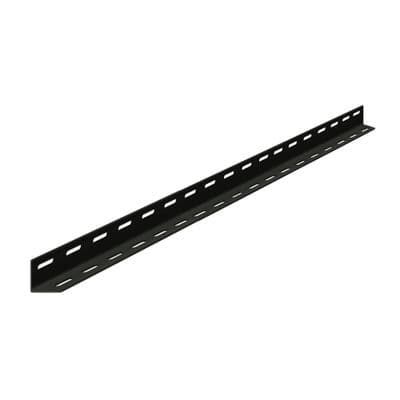
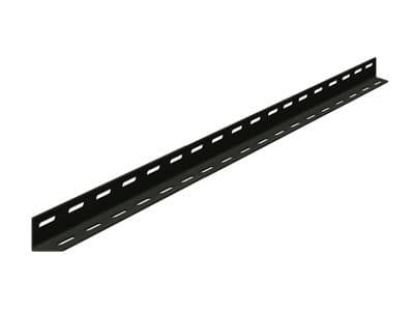
This perforated angle bar with a thickness of 2.0 mm, 1.5-inch legs, length of 3 meters, and black finish is the maximum version in this size range. Two millimeters is no longer just an angle bar — it's a full-fledged structural element that doesn't bend in your hands and clinks with a solid metallic sound. The holes are ready, no welding needed. The stated 150 kg per shelf is not an abstract number, but a real load capacity for shelving that holds engines, transmissions, 50 kg bags of cement, blocks, and heavy machinery.
The angle bar is intended for the most demanding storage organization tasks. In professional garages and auto repair shops, it is used to build shelving for engine blocks, transmissions, axles, and wheel rims with tires installed. In industrial warehouses — for storing steel stock, pipes, drums of fuel and chemicals, and large spare parts. In workshops and manufacturing facilities — for frames for heavy machinery (drill presses, lathes, milling machines), for jib cranes and hoists. The angle bar is also used in constructing mezzanines in factories, reinforcing old metal structures, and making industrial platforms.
The main advantage is the absolute maximum strength in the 38 mm format. With standard 1.5-inch legs, the 2.0 mm angle bar provides 150 kg per shelf — more than twice the capacity of the 1.2 mm version, and 30% more than the 1.8 mm version. The black coating is not just paint, but anti-corrosion protection that holds up even when scratched. The holes are spaced conveniently for assembling shelving of any configuration without unnecessary perforations. Everything assembles with bolts — no welding, no special tools. If you need shelving that doesn't just feel "probably fine" but guarantees 150 kilograms per shelf — this angle bar is one of those you don't debate, you just install. 2 mm thickness in a 38 mm angle bar is the case where the safety margin is already built into the material.