Gantries and Industrial Trestles in Dubai: Fabrication, Types, Applications
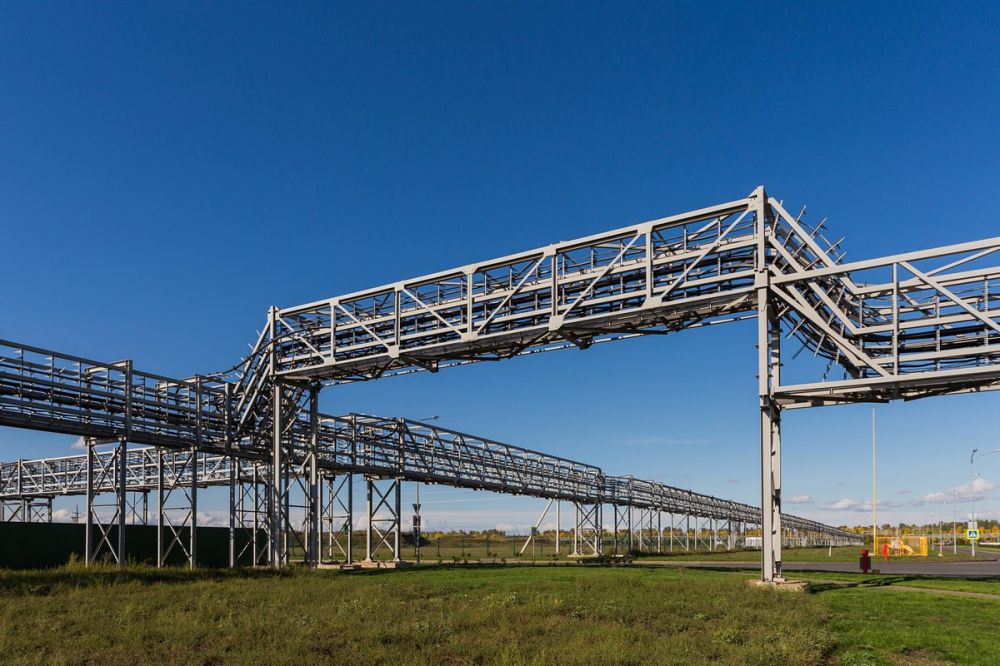
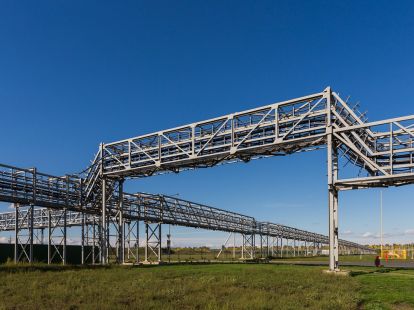
A gantry or industrial trestle is a metal structure made of supports and spans that creates a path above ground, water or other obstacles. Unlike a bridge, a trestle can be not only for transport but also technical, used for laying pipes, cables and utility networks. In Dubai, gantries are used in industry for loading and unloading oversized objects, on production sites for access to equipment, in logistics centres for container handling and in the oil and gas sector for laying pipelines. The main advantage of a trestle over ground level laying is access to the space underneath and protection from temperature variations and mechanical damage.
Types of gantries and trestles
Industrial trestles for loading and unloading are installed along warehouse hangars and production workshops. The height of such a trestle matches the floor level of a truck or container carrier. A forklift drives onto it and goes directly into the truck body without additional ramps. Carriageway width ranges from three to six metres. Length ranges from ten to one hundred metres depending on the number of loading bays.
Technical trestles for laying pipelines and cables are used at oil terminals, power plants and chemical production facilities. They carry pipes for oil, gas, steam, industrial water, as well as power cables and communication cables. The width of a technical trestle ranges from one and a half to three metres. Height ranges from one to five metres depending on terrain and safety requirements. Spans between supports range from six to twelve metres.
Crane gantries serve as tracks for gantry cranes at open yards and container terminals. Unlike crane rail tracks laid on the ground, a crane gantry raises the rail to a height of one to three metres. This allows the crane to move above stacks of containers or cargo. Track width ranges from ten to thirty metres. Trestle length matches the length of the crane's working area.
Transport trestles are installed on busy road and railway sections where traffic flows need to be separated at different levels. In Dubai, such trestles are used at the interchanges of Sheikh Zayed Road, on approaches to Jebel Ali Port and in industrial areas where a road crosses process pipelines or conveyors.
What trestles are made from
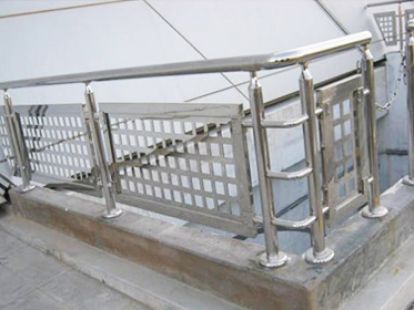
Trestle supports are made from steel hollow profile tube with square cross section from one hundred by one hundred to two hundred by two hundred millimetres and wall thickness from four to eight millimetres. Smaller section tubes are used for vertical posts and diagonal braces between them. Span structures, the beams on which decking or pipes are laid, are made from I-beams with a height of two hundred to five hundred millimetres or from hollow section trusses for spans over ten metres. Decking for industrial trestles is chequer plate with a thickness of six to ten millimetres. Handrails and guards are made from tube with a diameter of thirty two to forty two millimetres. After welding, all steel elements are sandblasted, primed and coated with powder coating. For trestles in aggressive environments or areas with constant humidity, hot dip galvanising is used.
How trestles are designed
Design begins with three parameters: the length of the trestle, the width of the carriageway or the number of pipe lines, and the height from ground level to the bottom of the span. The client provides these figures or sends a site layout. Engineers calculate the support spacing. The heavier the load, the closer the supports are placed. For a pedestrian trestle, support spacing can be up to twelve metres. For a crane gantry under a thirty tonne gantry crane, support spacing ranges from four to six metres. For a technical trestle under pipes, support spacing is determined by the pipe diameter and the weight of the contents. At the same time, the foundation is calculated: the depth of support embedment and the type of fixing. On concrete floors of industrial buildings, supports are welded to embedded plates. On the ground, supports are cast into individual concrete foundations or tied together into a strip footing. All calculations are performed taking into account the permanent load from the self weight of the trestle and pipes, the live load from cranes and people, and the wind load according to the Dubai wind map.
Fabrication stages
Metal cutting. Channels, tubes, I-beams and plate are cut into blanks to the dimensions shown on the drawing. Cutting is performed on band saws and CNC plasma cutters. Length tolerance is plus or minus one millimetre.
Part preparation. Edges on tube and beam ends are milled for welding. Holes are drilled for bolted connections on sections that will be joined on site. Braces made from tube are bent on a pipe bending machine.
Section assembly. The trestle is divided into transportable sections with a length of six to twelve metres so that they fit onto a truck. Each section is assembled on an assembly jig. Vertical posts are aligned using a spirit level. Braces are fixed with clamps. All angles are checked with a square.
Welding. Welding is performed using a semi automatic welder in a carbon dioxide atmosphere. The welding mode is selected for the metal thickness. Welds on load bearing joints are double sided. After welding, slag and spatter are removed and welds are ground down to clean metal.
Quality control. Every weld undergoes visual inspection for cracks, porosity and lack of fusion. On supports and span connection joints, selective ultrasonic inspection is performed. The finished section is checked for geometry: verticality of posts, parallelism of beams, and section diagonals. Diagonal deviation must not exceed two millimetres per metre.
Corrosion protection. The finished section is sandblasted to Sa 2.5 standard, meaning clean metal without rust or mill scale. Then primer is applied in one layer using airless spray. The finishing coat is powder coating or two component enamel. Coating thickness ranges from eighty to one hundred twenty microns. For operation in high humidity conditions or outdoors, hot dip galvanising by immersion is used.
Areas of application
Industrial trestles for loading and unloading at warehouses for construction materials, rolled metal and container terminals. Technical trestles for laying pipelines at oil depots and gas distribution stations. Crane gantries for gantry cranes at container terminals at Jebel Ali Port and at open yards in heavy machinery manufacturing. Transport trestles for separating vehicle and pedestrian flows in industrial areas. Trestles for servicing tanker wagons at chemical plants. Trestles for laying cable lines between power plant buildings.
Why trestles are better than ground level laying
The space under a trestle remains free. Equipment can pass underneath, goods can be stored, or people can walk. Pipes and cables on a trestle are not flooded during rain, not covered by sand and not damaged by passing vehicles. Maintaining pipes on a trestle is easier than underground or on the ground: there is no need to dig a trench, just climb a ladder. Repairing one pipeline does not require shutting down adjacent pipes because there is a walkway between pipes on the trestle. When production expands, new pipes or cables are laid in free spaces on the existing trestle without stopping current operations.
Volumes and lead times
Minimum order is three tonnes of finished structures. A standard trestle section six metres long and two metres wide weighs from eight hundred kilograms to one and a half tonnes depending on the load. Fabrication time for the first section starts from five working days after drawing approval. For orders of ten sections or more, production runs in parallel and lead time increases to ten to fifteen working days. Delivery of sections is only possible by truck with a crane manipulator because the weight of one section exceeds two hundred kilograms. Installation on site is ordered separately, but all sections are supplied with assembly diagrams and a bolt specification.