Mezzanine Floors in Dubai: Fabrication of Industrial Metal Structures
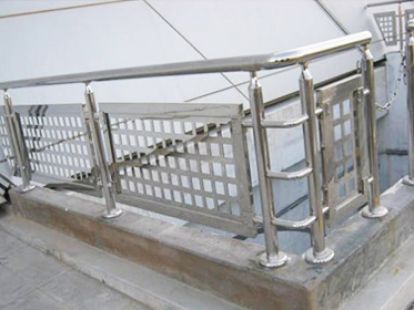
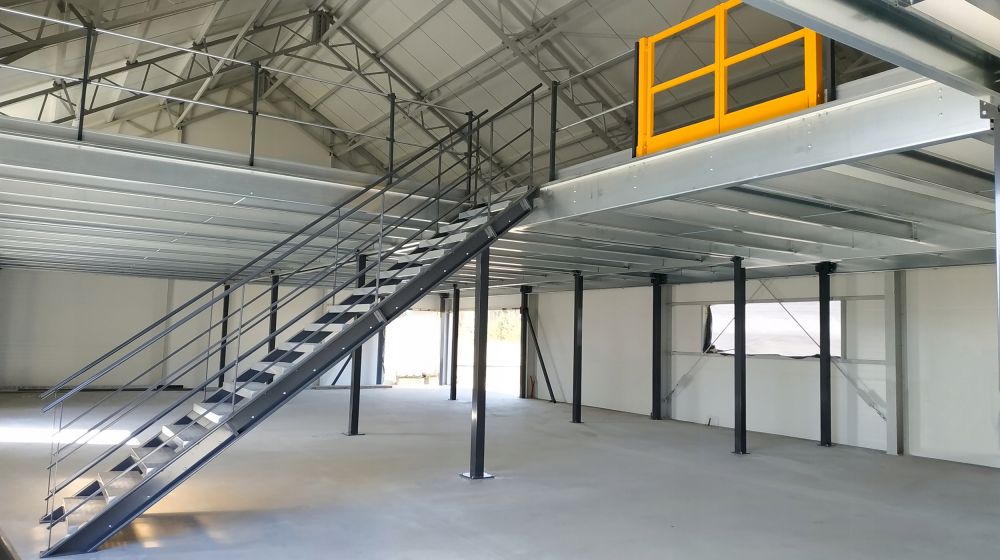
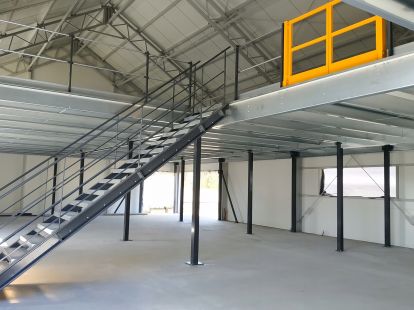
A metal mezzanine floor is an internal structure on supports that creates an additional level inside an existing building. Unlike a full second floor, a mezzanine does not require rebuilding the building, pouring concrete slabs or altering the facade. In Dubai, mezzanine floors are used in warehouses, production workshops, hangars, retail halls and even in offices with high ceilings. The structure is assembled by welding or bolting, rests on the floor and is attached to the building walls when necessary. A mezzanine floor must be equipped with guardrails around its entire perimeter at a height of ninety to one hundred ten centimetres. The only exception is sections adjacent to a solid wall.
Where mezzanine floors are used
In warehouses, a mezzanine allows vertical space to be used for goods storage. The lower level remains open for forklift traffic while slow moving stock is placed on the upper level. In production workshops, mezzanines house administrative zones, supervisor rooms, tool and equipment storage. In retail halls, mezzanines provide additional display space, staff offices or customer zones. In hangars and greenhouses, a mezzanine serves as an observation platform for equipment monitoring and storage of seasonal materials. In offices with ceiling heights of five metres or more, a mezzanine creates a second level for meeting rooms, libraries or break areas.
Types of mezzanine floors by construction
By connection method, mezzanines are divided into welded and bolted assemblies. Welded mezzanines are stiffer and cheaper but cannot be dismantled and moved to another location. Bolted mezzanines are more expensive but allow the structure to be disassembled during a move and reassembled at a new site.
By support type, mezzanines are freestanding on their own columns or wall mounted where one side rests on the building wall through embedded plates. Freestanding mezzanines are placed in the centre of large halls. Wall mounted mezzanines run along walls and save floor space.
By decking type, mezzanines are made with chequer plate steel from four to six millimetres thick, with open bar grating or with plywood over a metal frame. Chequer plate provides a solid surface and is suitable for small goods warehouses. Bar grating allows light and air to pass through to the lower level and is used in workshops and production areas.
What mezzanine floors are made from
Support columns for mezzanines are made from hollow profile tube with square cross section from eighty by eighty to one hundred fifty by one hundred fifty millimetres and wall thickness from four to six millimetres. Floor beams are made from I-beams with a height of one hundred to two hundred millimetres or from channels. Diagonal braces and connections between columns for rigidity are made from angles or smaller section tubes. Decking is made from chequer plate four to six millimetres thick or from bar grating. Guardrails are welded from hollow profile tube twenty by twenty or twenty five by twenty five millimetres. The staircase to the mezzanine is made from channels for the stringers and chequer plate for the treads. After fabrication, all steel elements undergo sandblasting, priming and powder coating.
How mezzanine floors are designed
Design begins with measuring the building. Engineers record ceiling height, floor plan dimensions, column locations and openings. The minimum ceiling height for mezzanine installation is five metres. At a height of five metres, the usable height on the second level will be approximately two metres. At six metres or higher, the mezzanine can comfortably accommodate work and large goods storage. The client then specifies the load per square metre of the floor. For warehouse mezzanines, the design load ranges from three hundred to six hundred kilograms per square metre. For production and office mezzanines, two hundred to three hundred kilograms is sufficient. Based on the load and the span between supports, the engineer calculates the beam cross section. The larger the span and the higher the load, the taller the required I-beam. Standard column spacing ranges from three to six metres. The staircase is calculated at the same time: width from eighty to one hundred twenty centimetres, slope from thirty to forty two degrees.
How mezzanine floors are fabricated
Metal cutting. Hollow profile tube, I-beam, channel and plate are cut to the dimensions shown on the drawing using band saws or plasma cutters. Length tolerance is plus or minus one millimetre.
Part preparation. Holes for bolts are drilled in the ends of beams and columns if the structure is bolted. For a welded mezzanine, edges are prepared for welding. Base plates for columns are cut from plate ten to twenty millimetres thick.
Section assembly. The mezzanine is divided into sections up to three metres wide for transport convenience. Each section is assembled on an assembly jig. Columns are aligned vertically. Beams are placed onto the columns and fixed by welding or bolts.
Welding. Welding is performed using a semi automatic welder in a carbon dioxide atmosphere. Welds at the connections between columns and beams are double sided. All welds are cleaned of slag.
Quality control. Every weld undergoes visual inspection. On load bearing joints, selective ultrasonic inspection is performed. The finished section is checked for geometry: horizontal alignment of beams, vertical alignment of columns, and section diagonals.
Corrosion protection. Finished sections are sandblasted. Primer and powder coating are applied. The coating colour is agreed with the client. For warehouses with chemical activity or high humidity, hot dip galvanising is offered.
Installation of mezzanine floors
Installation begins with marking column positions on the floor. Holes for anchor bolts are drilled with a rotary hammer. Hole depth depends on anchor length. Anchors are installed and tightened. On weak floors, separate concrete foundations are poured under the columns. Then the columns are installed. Columns are levelled and temporarily fixed with braces. Main beams are placed onto the columns. Beams are welded or bolted to the columns. Then secondary beams are placed at intervals of fifty to one hundred centimetres depending on the decking type. The decking is placed and welded onto the beams. After decking, guardrails are installed. Guardrail posts are placed every one hundred to one hundred fifty centimetres. The handrail is welded on top, and an intermediate rail is welded in the middle. The staircase is installed last. After assembly is complete, all bolted connections are checked for tightening torque. A walk test is performed: the decking must not deflect under a person's weight, and guardrails must not wobble.